
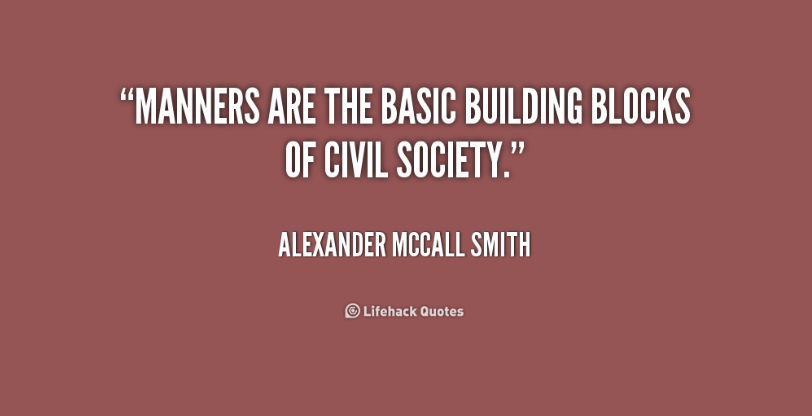
Lovely quote and one that many would agree with, however, it does beg the question as to whose “society” would the displayed manners be considered “civil” in and gets to the heart of this week’s lesson on how different cultures view “good manners.” As always, the discussion Brother Ivers has with his students was wonderful for explaining how our differing points of view could lead to severe misunderstandings and personal bias when dealing with our fellow man. One example, the all-night party, in particular, really hit home, as this has been something our neighborhood has been dealing with for a number of years. For those of us who live in Arizona, it is quite common to see the strong influence the Hispanic culture has had in many parts of the Valley and, while this can be incredibly amazing to learn about and experience, it has also led to quite a bit of contention as many of our cultural paradigms do not always align. In this case, multiple times a year, one of our neighbors throws a celebration that includes a live band until the wee hours of the morning and, while the police are often called to deal with the noise level, this has not changed the party throwers perception that his neighbors are comfortable with his cultural norms. His “rudeness,” in the eyes of the neighborhood, should be self-evident and, as a whole, they are not overly inclined to excuse what they feel should have become a non-issue long ago. These attitudes, on both sides, accurately represent how ingrained our personal belief systems on manners can be and should be something we, as teachers, are aware of in the classroom environment.
Manners, according to the Cambridge Dictionary are “ways of behaving toward people, esp, ways that are socially correct and show respect for their comfort and their feelings,” and are often felt to be ingrained from a very young age. In the classroom, these almost subconscious forms of behavior can result in either positive or negative student interaction and can affect how peer pressure may be applied to “correct” the situation. This has the potential to become problematic in the inclusion setting, as the consensus may be the views of the many versus the one, however, in the sheltered or 50/50 environment, there may be more opportunities for open discussion and equal understanding to be reached by both students and teachers, as having knowledge of why people exhibit certain behaviors can eliminate or reduce tension, I feel a lesson on cultural manners should be fundamental for all classrooms, including those who may not be as diverse, since this realization that not all viewpoints are similar can expand thought processes and cultivate the tolerance, respect, and love we need to see mankind as our brothers and sisters and not as separate or “other.”
References:
“Meaning of Manners in English.” Cambridge Dictionary, dictionary.cambridge.org/us/dictionary/english/manners.
“Quotes about Basic Manners Eval(ez_write_tag([[970,250],’quotemaster_org-Box-3′,’ezslot_1′]));” Quotes about Hades (62 Quotes), http://www.quotemaster.org/basic manners.

