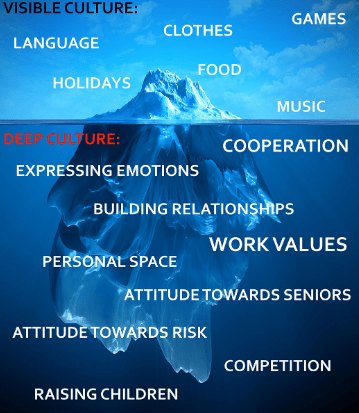
While visible culture, not unlike an iceberg, may only show the smallest portion of its impact above the water, deeper cultural perceptions, such as how one views themselves, what their life’s expectations will be, and how they will relate to those around them can be far greater than that tiny visible piece offered and effect personal interaction in both positive and potentially negative ways. As we have learned in the last few week’s lessons, cultural paradigms of manners, success, expressivity, and many others can be seen, not only differently, but sometimes in complete opposite of what one traditionally finds acceptable or pleasing and some great examples of these in the readings included how Japanese culture finds slurping their food as “good manners” and the Albanian methods for “yes” or “no” head movements as the reverse of Americans. These and many other instances demonstrate how often common, everyday items that are embedded into our belief systems are the result only of perception and not worldwide acceptance.
In the TESOL classroom, teachers often address the visible cultural diversity issues with lessons which can open discussions about differing holidays, food preferences, and feelings of nationalism, however, unless those lessons are expanded to include the deeper cultural beliefs, only superficial understanding can be reached and, while better than nothing at all, this can limit how students can truly get to really know one another and find acceptance on a more global platform. By introducing content that would contain more complex and critical thinking experiences, dialog and scenario exchanges, and information on how differing viewpoints may have come to be, students and teachers, can become more community-minded as function more effectively as a group. In my future and present classrooms, I hope to utilize many of these pieces and more to develop a learning environment of support, warmth, and understanding for all my students in order to better facilitate growth and provide them with success.
References:
“Canadian Culture.” English & Immigration, englishandimmigration.com/citizenship-immigration/canadian-culture/.